Complete Workflow
This tutorial covers a full experiment lifecycle:
- initialize a run
- log metadata, metrics, and artifacts
- finalize
- reconnect later
- retrieve metadata and files
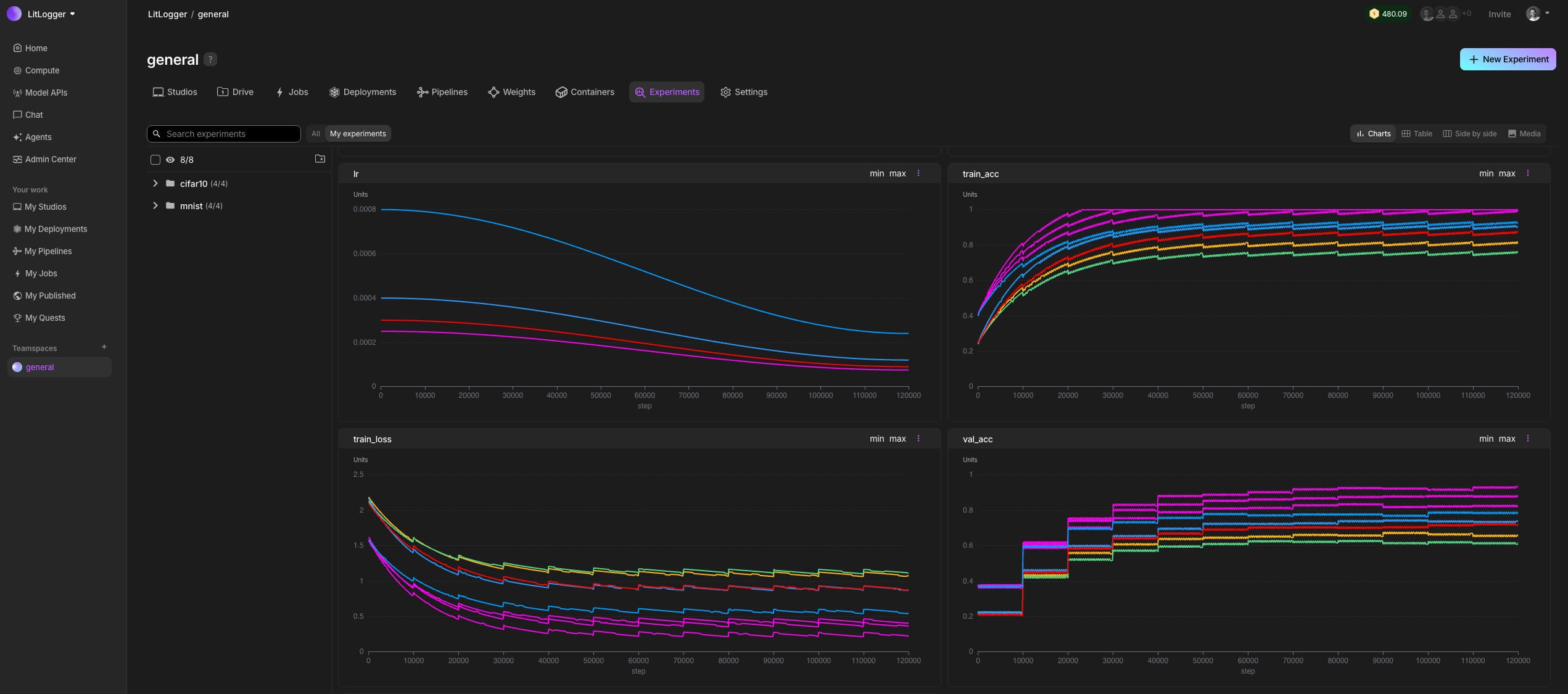
Train Script
import json

import litlogger
from litlogger import File

config = {"model": "ResNet50", "lr": 0.001}
with open("config.json", "w") as f:
    json.dump(config, f)

experiment = litlogger.init(name="image-classifier")

# Set metadata
experiment["model"] = "ResNet50"
experiment["dataset"] = "CIFAR10"

# Log a static file
experiment["config"] = File("config.json")

# Log training metrics
for epoch in range(10):
    experiment["loss"].append(1.0 / (epoch + 1), step=epoch)

experiment.finalize()
Fetch Script
"""Fetch data from a previously logged experiment.

This script resumes the 'image-classifier' experiment and reads back
metadata and artifacts using the dict-like API.
"""

import json

import litlogger

experiment = litlogger.init(name="image-classifier")

# Read metadata via property
metadata = experiment.metadata
print(f"Metadata: {metadata}")

# Read artifacts and download
artifacts = experiment.artifacts
if "config" in artifacts:
    artifacts["config"].save("/tmp/config.json")
    with open("/tmp/config.json") as f:
        print(f"Config: {json.load(f)}")

experiment.finalize()
What This Covers
- experiment creation by name
- metadata logging
- metric logging
- artifact upload
- reconnection to an existing experiment
- file download and metadata access
Related Guides
Was this page helpful?
Thanks for the feedback.